Best Google Ads MCP Servers in 2026 (Compared)
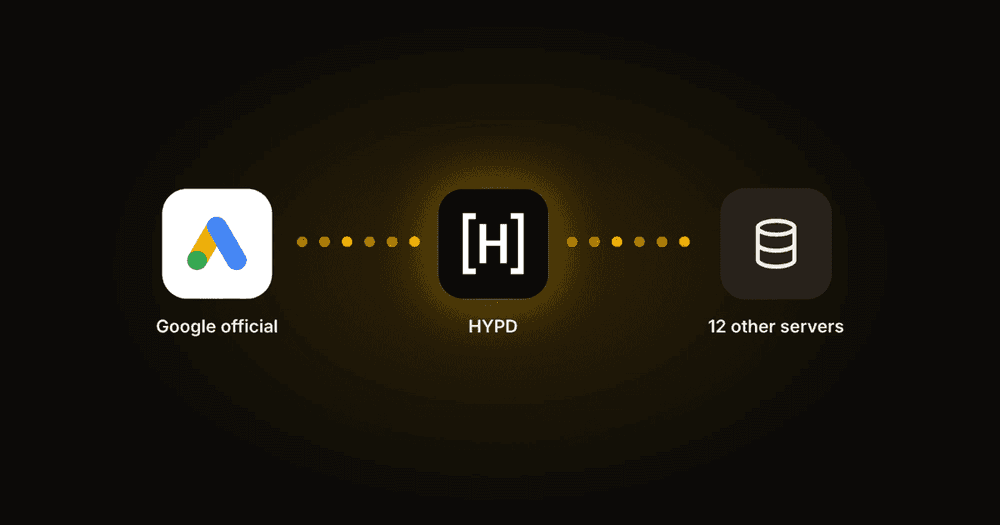
The best Google Ads MCP server depends on what you want the AI to do. HYPD is hosted, works in Claude and ChatGPT, and is read-only by default: nothing changes in the account until a human approves it. Google’s official Google Ads MCP server is strictly read-only, and you host it yourself. Supermetrics makes sense if you already pay for it and want 150+ data sources in one place.
We compared 14 Google Ads MCP servers throughout 2026, those three in depth and eleven more in one table. We connected a real Google Ads account, ran the same prompt, read Google’s documentation ourselves, and we say where another server is the better choice.
The short answer: safe defaults for marketers, self-hosting for developers
HYPD is the pick for agencies, small businesses and store owners: a hosted Google Ads MCP server that connects with a Google sign-in, stays read-only until you switch writes on, and puts every change through your approval, with plans from $0 to $279.99 a month. Google's official server is free and first-party but self-hosted and read-only, which makes it the right choice for developers and data teams who only want reporting and can run their own Google Cloud project. Supermetrics MCP fits teams already paying for Supermetrics who want ads data blended with 150+ other sources. Everything else on the market is a hosted write-access server, and the deciding question is what sits between the model and your budget.
What a Google Ads MCP server is
A Google Ads MCP server is software that exposes the Google Ads API to an AI assistant as a set of tools it can call, so Claude or ChatGPT can pull a search terms report or check budget pacing inside a conversation instead of you exporting a CSV. MCP, the Model Context Protocol, is the open standard Anthropic published in November 2024 for connecting AI assistants to outside tools and data. Google, OpenAI and most AI clients now speak it, which is why more than a dozen Google Ads servers appeared within a year.
Three things split the field. Who hosts the server: you, on your own Google Cloud project, or a vendor. What the server can do: read reports, or also change bids, budgets, keywords and status. And what stands between the model and a live change: a preview, an approval step, an audit log, or nothing. Tool counts, the number every vendor page leads with, tell you almost nothing about any of the three, and every verdict below comes back to them.
How we compared them
We judged each server on hosting, access model, what checks a write, platform coverage beyond Google Ads, which AI clients it works in, setup effort, and price. For Google's server we used the developer documentation and the GitHub repository, both read on November 9, 2026. For Supermetrics we used its product and support pages. For HYPD we used the product and our own account. For the smaller servers in the long table we repeat what their own pages said in early November 2026 and nothing more, because we did not connect live accounts to all of them.
Our stake: we build HYPD. We support both Claude and ChatGPT, so the model side of this comparison has no thumb on the scale (we've compared Claude and ChatGPT for Google Ads separately, and ChatGPT wins a few rounds). The server side does, so weigh our verdicts accordingly and check the links.
Google's official Google Ads MCP server
Verdict: the best choice for developers and data teams who only need reporting, and the wrong one for almost every working marketer.
Google released its Google Ads MCP server as an open-source Python project in October 2025, and Google's developer documentation describes the implementation as strictly read-only. It exposes three tools: list_accessible_customers, which returns the accounts your login can reach; search, which runs GAQL queries; and get_resource_metadata, which describes the fields on a resource. It runs locally over stdio or Streamable HTTP, or you deploy it to Cloud Run. The repository had 1.1k GitHub stars when we checked.
Setup is the filter. You need a Google Cloud project with Google Ads API access, and either an OAuth client or application default credentials. The one piece of good news is that Google sunset developer tokens on September 9, 2026, so the latest version no longer asks for one. Claude and ChatGPT connect to it through custom connectors using OAuth, which in practice means you host the server somewhere reachable and wire up OAuth yourself. For a developer who already has API access, that's an afternoon. For a media buyer, it is where the project usually dies.
Where it wins: it's free, first-party, and gives raw GAQL with no vendor in the middle. Where it loses: it cannot add a negative keyword, pause an ad, or see your Meta account, and when Claude writes its own GAQL it will write bad GAQL some of the time, with nothing in the server to catch it.
Watch out: one vendor comparison claims a November 2026 release added asset and label writes to Google's server. Google's documentation, last updated October 30, 2026, still says strictly read-only, and the releases page did not show that version when we looked on November 9. Treat it as read-only until Google's own docs say otherwise.
HYPD
Verdict: the best fit for agencies, small businesses and store owners who want a hosted server with read-only defaults and human approval on every change. The wrong fit if you want to self-host, or want an AI executing a hundred write operations without asking.
HYPD is the AI co-pilot for performance marketers: it connects Google Ads, Meta Ads, GA4, Merchant Center, Search Console, Microsoft Ads and LinkedIn Ads to Claude and ChatGPT through MCP, read-only by default, EU-hosted and GDPR-compliant. On Google Ads it exposes more than 40 tools covering performance reporting across accounts, account structure and conversion tracking audits, Keyword Planner volumes and SERP data, competitor creatives from the Ads Transparency Center, landing page and pixel checks, and wasted-spend analysis on search terms and pacing.
Setup is a Google sign-in. There is no Cloud project and no OAuth client to create. In Claude you add "HYPD AI Ads" from the connector directory; in ChatGPT, Cursor and other MCP clients you paste your HYPD server URL. The agency guide to connecting Google Ads to Claude or ChatGPT safely walks through the permissions screen by screen. Then you decide which accounts each teammate and each AI tool can see, per account.
Write access works the way we think every one of these servers should. It is off until you turn it on, per account and per platform. When it is on, the AI drafts the change (a budget update, a bid strategy switch, negative keywords, a pause, new responsive search ad copy) and nothing happens until you approve it. Every approved change is logged and can be reverted, and the AI never calls the Google Ads API directly; HYPD's own tested change logic does. Data is live from the API and not stored, hosted in the EU under GDPR.
Pricing is public: Free Forever at $0 for one account, Starter at $19.99 a month for up to 3 accounts, Plus at $59.99 for 10, Pro at $119.99 for 50, and Agency at $279.99 for 250. Every plan includes every platform and both Claude and ChatGPT, and paid plans come with 14 days free and no credit card. The same connection covers Meta Ads, so a cross-channel question takes one prompt.
Where HYPD loses: there is no self-hosted option, so if your security policy says nothing leaves your cloud, Google's server is your answer. The write surface is deliberately narrower than the write-first servers, so if you want the AI to build a Performance Max campaign from scratch, look elsewhere. Research and competitor tools need the Starter plan or higher. And HYPD's documentation tells you to connect advertiser accounts rather than analyze through the MCC itself, which agencies should read before onboarding fifty clients.
Supermetrics MCP
Verdict: the best pick if you already pay for Supermetrics and want Google Ads data blended with the rest of your marketing stack. Overkill if you only want to talk to Google Ads.
Supermetrics MCP is included with any Supermetrics subscription and connects Claude, ChatGPT, Copilot, n8n and any other MCP client to more than 150 sources, Google Ads among them. You enable it from the Supermetrics Hub, authorize with OAuth, and each user sees only the accounts they are authorized for in Supermetrics. The server sits on a semantic layer that normalizes metrics across platforms, which matters when you ask one question about Google and Meta together and want the two "conversions" columns to mean the same thing.
Supermetrics is SOC 2 Type II certified and queries platforms on demand rather than storing raw ad data. On changes, Supermetrics' own documentation is specific: campaign changes are available in supported Claude workflows and not currently through ChatGPT. In ChatGPT it's a reporting server; in Claude it can also make changes.
Where it wins: cross-channel breadth and metric normalization that none of the ads-only servers attempt. Where it loses: there is no standalone MCP price, so you are buying Supermetrics to get it; the PPC workflow layer (audits, negatives, prompt library) is thinner because Supermetrics is a data company first; and write access depends on which assistant you use.
The rest of the field, in one table
Google, HYPD and Supermetrics are the three we tested or documented in depth. The servers below are the rest of what you will find in search results and AI answers. We repeat what their own pages said in early November 2026. We left the links out on purpose; each is one search away.
| Server | Hosting | Access model | Beyond Google Ads | What their pages say |
|---|---|---|---|---|
| AdPlug | Hosted | Read and write, preview before execute | Meta, LinkedIn, Microsoft, Reddit, Search Console | Free tier, read-only by default |
| PaidSync.ai | Hosted | Read and write, previews and paused creation | Meta, LinkedIn, Microsoft, GA4, others | 158 Google Ads tools, free for 100 tasks a month |
| Markifact | Hosted | Read and write, human approval per write | 14 platforms plus automation suite | 60+ Google Ads tools, credit-based pricing |
| Pipeboard | Hosted or self-hosted | Read and write, campaigns created paused | Google-focused | 59 Google Ads tools, source-available license |
| Ryze AI | Hosted | Read and approval-gated write | Multi-platform | 14 Google Ads tools, OAuth setup |
| Adspirer | Hosted | Read and write, AI asks first | Meta, Amazon, LinkedIn, TikTok, ChatGPT Ads | Free tier of 15 tool calls a month |
| AdKit | Hosted | Read and write, draft-first | Meta, TikTok, LinkedIn, Microsoft, Reddit, X | Paid subscription |
| Windsor.ai | Hosted | Reporting plus basic changes since May 2026 | 350+ data sources | Free tier for one source and one account |
| Whatagraph | Hosted | Read-only | Reporting platform | Connects at MCC level |
| cohnen/mcp-google-ads | Self-hosted | Read-only | Google only | Open source, needs your own API access |
| Zapier MCP | Hosted | Read and write, generic actions | Thousands of apps | Task-based pricing |
If a row is wrong, the vendor's page changed after we read it. Every comparison on this topic is a dated snapshot, and that goes for ours.
The verdicts in one table
| Google (official) | HYPD | Supermetrics MCP | |
|---|---|---|---|
| Built by | Google Ads API team | HYPD, Berlin | Supermetrics |
| Hosting | Self-hosted (local or Cloud Run) | Hosted | Hosted |
| Access model | Read-only, 3 tools | Read-only by default, write per account on request | Read; writes in Claude only |
| What checks a write | No writes | You approve each drafted change; logged and revertible | Depends on Claude workflow |
| Beyond Google Ads | Nothing | Meta, GA4, Merchant Center, Search Console, Microsoft, LinkedIn | 150+ marketing and sales sources |
| AI clients | Any MCP client; Claude and ChatGPT via custom connector | Claude (directory), ChatGPT, Cursor, others via URL | Claude, ChatGPT, Copilot, n8n |
| Setup | Cloud project, API access, OAuth client, hosting | Google sign-in, 3 steps | Supermetrics account, Hub, OAuth |
| Data handling | Your infrastructure | Live API data, not stored, EU-hosted | Queried on demand, not stored, SOC 2 Type II |
| Price | Free | $0 to $279.99 a month | Included in a Supermetrics subscription |
| Best for | Developers and data teams, reporting only | Agencies, SMBs and store owners who want safe defaults | Teams already on Supermetrics |
What we found when we pointed it at a real account
The first ten minutes on a live account tell you more than any feature table. We ran this on a Canadian exam-prep business one of our team runs on the side, in Claude via HYPD, on November 9, 2026, over the trailing 30 days. Currency is GBP, figures rounded.
Pull the last 30 days of search terms for this account, find the terms that spent money with zero conversions, and tell me which ones are actually worth a negative keyword.
What came back, in order of usefulness:
| Finding | What the data showed |
|---|---|
| Campaign imbalance | Two live campaigns spent about £600 between them. One took 48% of the spend and produced 1 of the 12 conversions. |
| Non-converting terms | Of the 80 highest-spending search terms, 3 converted. The other 77 spent roughly £177. |
| Clear negatives | A competitor instructor's name (6 clicks, £6, no conversions), three "pdf" and "free" queries, and the brand's own "login" and "reviews" searches: paid clicks from people already looking for the site. |
| Campaign overlap | The same query, "electrical red seal exam prep", was bought in both campaigns at once, about £8 total. |
The first row is the one a weekly dashboard would never surface on its own, because dashboards show you each campaign's CPA and leave the comparison to you. The fourth is the one most marketers find only when they export search terms into a spreadsheet and sort by query. All of it took about ten minutes.
From our tests: the model also flagged the single highest-spending term, "industrial electrician red seal exam preparation" (£14, no conversions), as waste. That term is the exact course the campaign exists to sell, and a 30-day window is too short for a purchase that follows weeks of study. Anyone who runs the account knows that in half a second. The model doesn't, and no server on this page can tell it.
Where every Google Ads MCP server falls short, ours included
AI connected to a live account is excellent at the grunt work and unreliable at the judgment, and no MCP server fixes that. The example above shows the pattern: it found the campaign imbalance and the duplicate query faster than a person would, then called the core product a waste of money because the attribution window said so. Every server on this page hands the model the same raw numbers, and not one of them knows what your business sells.
Attribution windows are the second trap, and they're why the model got that term wrong. A 30-day search terms report with a 30-day conversion window undercounts anything with a long consideration cycle, so the model will happily recommend negatives on terms that convert in week five. HYPD's change-approval step exists for exactly this reason. It still relies on you knowing why the number is misleading.
Then there's GAQL. On the official server, and on any server that exposes a raw query tool, the model writes its own queries, and it will occasionally invent a field, mis-segment a date, or sum a metric that shouldn't be summed. The result still looks like a report. Check a number against the Google Ads UI before it goes in a client deck.
Write access is where the market is racing, and tool counts in the triple digits have become a marketing metric. A tool count tells you nothing about what happens when the model is wrong. The numbers worth asking a vendor for are how a change is previewed, who approves it, where the log lives, and how you undo it.
The last one is ours to own. In October 2026 we ran 100 buyer prompts about managing ads with AI through ChatGPT, Claude, Gemini and Perplexity, 400 responses in total. Across the 384 responses that did not name HYPD in the prompt, HYPD came up twice. The most-mentioned third-party server came up 48 times. Plain-language marketer prompts, the ones without the word "MCP" in them, mostly didn't surface any connector at all. We're writing this article partly to fix that, and you should read every vendor's comparison knowing that is the game being played.
Which Google Ads MCP server should you pick?
Pick by your situation, not by tool count.
You run accounts for clients: use a hosted server with read-only defaults, per-account permissions, and an approval step with a log. That is how HYPD's Google Ads MCP is built, and several write-first servers in the long table document a preview or approval layer of their own. Do not connect a client account to anything that executes writes without one.
You have a developer and only want reporting: run Google's official server. Free, first-party, full GAQL, and nobody else's terms of service.
You run your own store or small business: the free HYPD plan covers one account, and the wasted-spend and conversion-tracking audits are the two prompts that pay for the ten minutes. Skip the client-reporting features.
You already live in Supermetrics: turn on its MCP and blend Google Ads with the rest. Add an ads-specific server later only if you want negatives and pauses from the chat.
You want the AI to build and restructure campaigns: that is a write-first server, and your shortlist is in the long table. Model the monthly operation caps before you commit, and demand the preview step in writing.
Pro Tip: whichever server you pick, run the same first prompt on day one: "Show me every search term that spent money with zero conversions in the last 30 days, grouped by campaign." It tests the connection, the data freshness and the model's judgment in one go, and you will know within ten minutes whether the tool is worth keeping. HYPD's prompt templates have a wasted-spend version ready to paste.
The best Google Ads MCP server in 2026 is the one whose safety model matches who owns the account. HYPD for marketers who want the connection safe by default and every change to pass through a human. Google's server for developers who want nothing in the middle and will host it themselves. Supermetrics for teams whose data already lives there. The model you plug in matters less than any of that: connection quality beats model choice, and an approval step beats both.
Connect your Google Ads account read-only on the free HYPD plan and run the first prompt above on your own data before you believe any comparison table, including this one.