Ads in AI Assistants Compared (2026): ChatGPT vs Google AI Mode, Perplexity and Copilot

Philip Mohr · Co-Founder & COO
· 12 min read
Ads in AI assistants now come in four very different shapes, and only one of them asks you to open a new ad account. If you run Google Ads or Microsoft Ads today, you are probably already in two of these placements without having chosen to be. The other two are a fresh platform with its own rules, and a door that closed in February.
The short answer: one new platform, two you're already in, one dead end
ChatGPT ads are the only AI assistant ads with their own buying platform, sold self-serve in 89 countries. Google AI Mode ads and Copilot ads serve from your existing Google Ads and Microsoft Advertising campaigns, with no separate targeting or reporting. Perplexity stopped selling ads in early 2026. The first independent data puts ChatGPT ad revenue at $0.89 per visit against $2.45 for Google Search ads.
Ads in AI assistants side by side
The four assistants differ most in how you buy and what you can see afterwards. This table reflects public documentation as of November 23, 2026.
| ChatGPT | Google AI Mode | Microsoft Copilot | Perplexity | |
|---|---|---|---|---|
| Ad status | Live, beta, self-serve | Live in listed markets, new formats in test | Live | None since early 2026 |
| How you buy | Separate OpenAI Ads Manager account | Existing Search, Shopping, Performance Max campaigns | Existing Microsoft Advertising search campaigns | Nothing to buy |
| Targeting | Conversation context plus advertiser "context hints" | Keywords, broad match, AI Max, feeds | Keywords, Performance Max, feeds | n/a |
| Pricing | CPM, CPC or conversion-optimized; $25 a day minimum in the US | Your normal auction | Your normal auction | n/a |
| Separate reporting | Yes, it is its own platform | No, blended into Search | Not documented | n/a |
| Can you opt out? | You simply don't buy | Not separately from Search | Not documented | n/a |
Verdict: ChatGPT is the only one you choose to enter. Google and Microsoft decide for you.
ChatGPT ads: a new platform with its own rules
ChatGPT ads are sponsored units shown below ChatGPT's answers to logged-in adults on the Free and Go plans. OpenAI started the test in the US on February 9, 2026, per its announcement. Plus, Pro, Business, Enterprise and Education users see no ads, and the same post keeps ads away from health, mental health and political topics. Advertisers see aggregate results only, never chats, chat history or memories.
Scale came quickly. On October 21, 2026, OpenAI said ChatGPT Ads had reached 89 countries and more than 100,000 advertisers, in its expansion announcement. Ads Manager is still labeled beta.
How you buy ChatGPT ads and what they cost
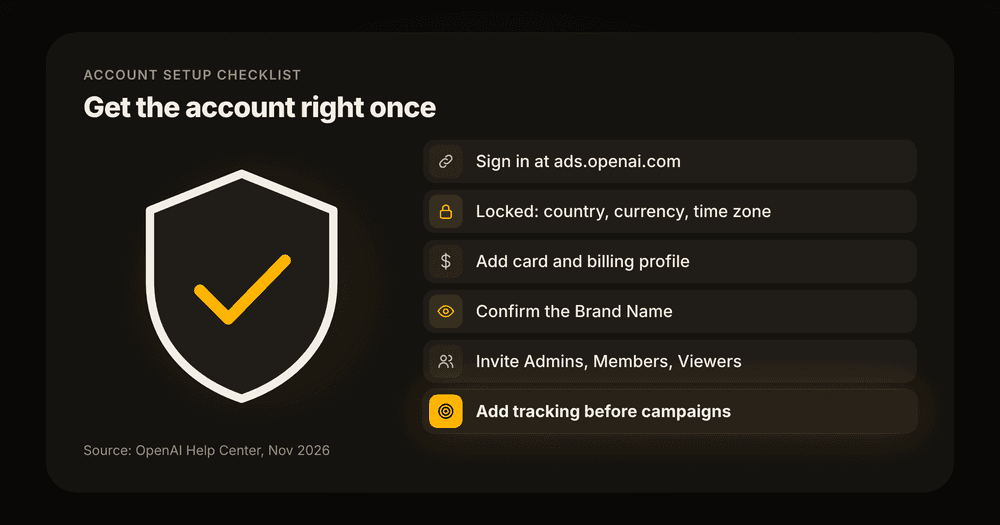
ChatGPT ads are bought in OpenAI's own Ads Manager at ads.openai.com, with campaigns, ad groups and ads. You pick Views (CPM), Clicks (CPC) or Conversions, and OpenAI's help center recommends starting CPC bids at $3 to $5. The minimum daily spend is $25 per campaign in the US and £15 in the UK, per OpenAI's campaign guide.
Agencies should note one gap. OpenAI has no equivalent of a Google Ads manager account (MCC) yet, as MarTech's setup guide points out. The client creates the account and adds the agency as a user.
Targeting: context hints, not keywords
ChatGPT ads match on the current conversation, your landing page and ad copy, plus optional "context hints" at the ad group level. OpenAI says plainly that hints are not exact-match keywords and do not guarantee delivery. If ads personalization is on, select signals from the user's wider ChatGPT history count too.
This is the biggest mental shift for search marketers. You describe the situations where your ad belongs, and OpenAI's system decides which conversations fit.
What you can measure in ChatGPT ads
ChatGPT Ads Manager reports impressions, clicks, spend, CTR, average CPC, average CPM and conversions. You can connect GA4 and upload product feeds for feed-based campaigns. There is no search terms report, because there are no search terms.
Verdict: worth a capped test for considered purchases, B2B and anything people research before buying. Not yet a place to move proven Search budget.
Google AI Mode ads: the campaigns you already run
Google AI Mode ads come from your existing Search, Shopping and Performance Max campaigns. No new campaign or budget is required, per Google's help page on ads in AI experiences. The same page says you can't target AI Overviews or AI Mode on their own, or opt out of them separately from Search. Results are folded into your standard campaign and search terms reports.
Ads above or below AI Overviews run in every market where AI Overviews exist. Ads inside AI Overviews and AI Mode are narrower: English only, in markets including the US, Canada, Australia, India, Singapore and the Philippines.
Which campaigns and match types are eligible for AI Mode ads
Match type decides how much of AI Mode you can reach. Broad match, AI Max for Search, Shopping and Performance Max can match the query and the AI response around it. Exact and phrase match only qualify when the query shows direct commercial intent, and never on broader exploratory questions.
That one rule decides more of your AI Mode reach than any of the new formats. A tightly built exact and phrase account is mostly locked out of the conversational part, though negative keywords and brand exclusions still work as controls.
New AI Mode ad formats: Direct Offers, Conversational Discovery, Highlighted Answers
Google announced three AI Mode formats at Google Marketing Live on May 20, 2026, on its Ads and Commerce blog. Conversational Discovery ads answer a specific question with Gemini-written creative. Highlighted Answers place an ad inside an AI Mode list of recommendations. Direct Offers, piloted since January 2026 with Chewy, Gap and L'Oreal, show a discount to shoppers close to buying.
Google is tying these formats to its own automation. AI Max and Performance Max advertisers can create Direct Offers in the Google Ads interface, per Google's Direct Offers page.
Watch out: Google also writes "AI explainers" next to some ads with Gemini. You can't write, edit or opt out of them, so check that your landing page says what you'd want summarized.
Verdict: the easiest AI assistant ads to get into and the hardest to measure. You are already there if you run broad match or AI Max.
Copilot ads: Microsoft Advertising inside a chat window
Copilot ads are drawn from your existing Microsoft Advertising search campaigns, per Microsoft's AI search guide for marketers. Text ads, feed-based ads such as Shopping, and multimedia ads are eligible. They show at the end of a Copilot answer, in English, French, German and Spanish-speaking markets where Copilot runs. Microsoft's guide pushes Performance Max hardest for Copilot.
Microsoft is also pushing commerce into the chat itself. Copilot Checkout began rolling out in the US on Copilot.com on January 8, 2026, with PayPal, Shopify and Stripe. The merchant stays merchant of record, according to Microsoft Advertising. Brand Agents, a shopping assistant trained on your catalog, opened to Shopify merchants at the same time.
Microsoft's own figures are upbeat. It says journeys that include Copilot led to 53% more purchases within 30 minutes, based on its August 2025 internal data. It's a platform's own number about its own product, so don't plan your account around it.
Verdict: if you already run Microsoft Ads, keep Performance Max healthy and you are covered. We wouldn't open a Microsoft Ads account just for Copilot.
Can you advertise on Perplexity?
You can't advertise on Perplexity in 2026. Perplexity tested sponsored follow-up questions from late 2024, wound them down during 2025, and confirmed in February 2026 that it was leaving advertising. eMarketer's summary quotes an executive saying users need to believe they get "the best possible answer."
The same eMarketer piece cites Ipsos: 63% of US adults say ads in AI search results make them trust those results less. That number is the whole argument against ads in AI assistants, in one line.
Claude is in the same camp. Anthropic said on February 4, 2026 that Claude will remain ad-free, with no sponsored links next to conversations.
Verdict: the only way into Perplexity and Claude answers is to be the source they cite. Anyone selling you a Perplexity ad buy is selling air.
Which AI assistant should you advertise in first?
Start where your money already sits, then test ChatGPT with a fixed budget. For most advertisers that order is Google AI Mode, then ChatGPT, then Copilot.
- Agencies: audit each client's match types and AI Max settings first, because that decides AI Mode reach. Run ChatGPT tests in client-owned accounts.
- SMB owners: your Google campaigns already reach AI Overviews. A ChatGPT test at the $25 daily minimum is about $750 a month, so set a stop date.
- E-commerce stores: feed quality matters on all three paid platforms. ChatGPT, Google Shopping and Microsoft Shopping all read product feeds.
Our read: the assistants differ less in ad format than in control. ChatGPT gives you a separate budget and report. Google and Microsoft give you reach you can't isolate.
What our own Google Ads account shows about AI Mode ads
Your own match types say more about AI Mode eligibility than any Google announcement. We ran this against a Canadian exam-prep business one of our team runs on the side. Canada is one of the markets where ads can show inside AI Mode. The account has two Search campaigns and spent about £650 over the 30 days to November 22, 2026.
The prompt, run in Claude on November 23, 2026, over the MCP connection described further down:
Pull the search terms for the last 30 days, group them by word count, and show impressions, clicks and spend per group. Then list the keyword match types in use and whether AI Max is on.
What came back (real account data, figures rounded):
| Query length | Search terms | Impressions | Share of reported impressions | CTR |
|---|---|---|---|---|
| 1 to 3 words | 158 | about 790 | 43% | 11.7% |
| 4 to 6 words | 203 | about 1,030 | 57% | 16.4% |
| 7 or more words | 2 | 3 | 0.2% | 0% |
The same run showed two settings. Every keyword that served is exact or phrase match, and AI Max is off on both campaigns. Under Google's rules, that keeps the account out of contextual matching on exploratory questions, which is where long conversational queries live.
The second finding was about visibility. The search terms report named queries for about 1,800 of roughly 10,150 impressions, or 18%. So the account can't prove what it gets from AI Mode, and it can't prove what it misses.
Pro Tip: run the same check before switching on broad match or AI Max "for AI Mode." The change will reach new queries, but your reports will still blend them into Search.
Where every platform falls short: measurement
Measurement is the weak spot across all ads in AI assistants, and no tool fixes it, ours included. Google blends AI Overview and AI Mode results into normal Search reporting. Microsoft's guide describes no Copilot-only report. ChatGPT reports cleanly, but only on its own clicks and conversions.
The first outside study is sobering. Researchers Maximilian Kaiser (WU Vienna) and Christian Schulze (Frankfurt School) looked at 102 advertisers with revenue tracking, per the Frankfurt School release. US visits from ChatGPT ads earned $0.89 each, against $2.45 from Google Search ads. Conversion rates were 0.37% and 1.17%. The authors call the analysis descriptive, so read it as a strong early signal.
AI also gets the judgment part wrong here. Ask any assistant, Claude included, whether AI Mode "worked" and it will happily compare before and after numbers. That comparison can't separate AI Mode from the match type change you made at the same time. A human has to design a holdout or accept the blur.
Running all four from one AI assistant
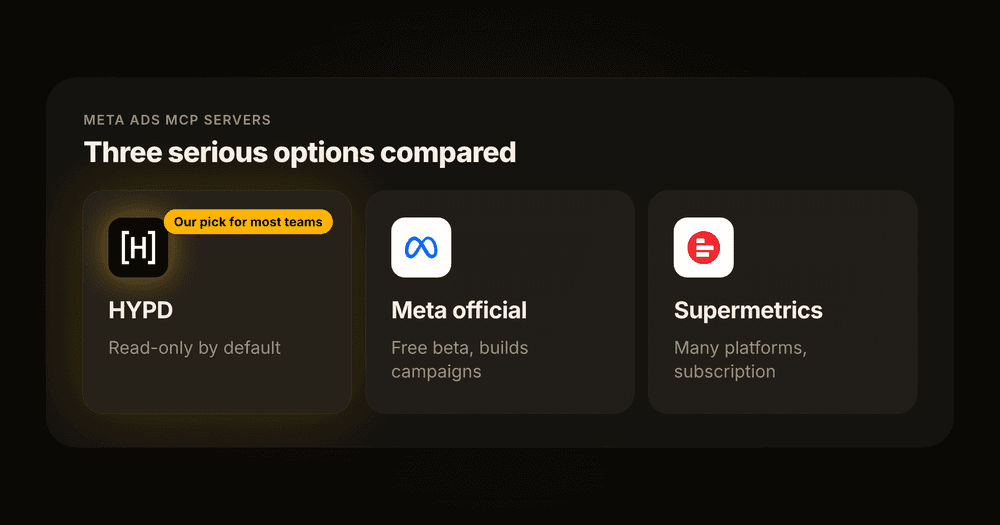
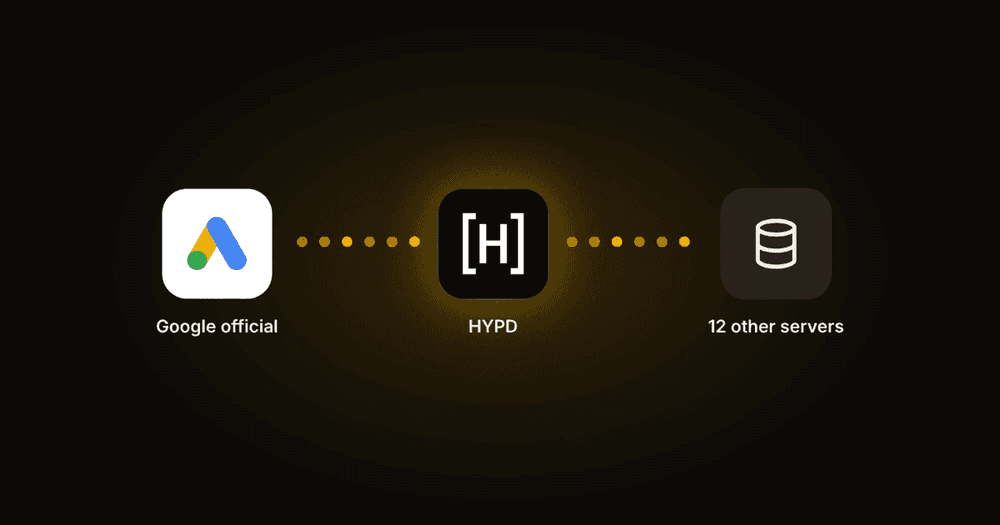
You can analyze Google AI Mode ads and Copilot ads from Claude or ChatGPT, because both live inside campaigns an MCP server can read. HYPD is the AI co-pilot for performance marketers: it connects Google Ads, Meta Ads, GA4, Merchant Center, Search Console, Microsoft Ads and LinkedIn Ads to Claude and ChatGPT through MCP, read-only by default, EU-hosted and GDPR-compliant. That covers the campaigns behind both placements, with Google Ads MCP data on one side and HYPD's Microsoft Ads connection on the other. In the main HYPD connector, write access is off by default; once switched on per account, every change waits for your approval, is logged and can be reverted.
ChatGPT ads sit outside the main HYPD connector today, and we would rather say so. HYPD publishes a separate OpenAI Ads MCP, free and open source, that reads campaigns, ad groups, ads and reporting through 11 read-only tools. It has no write access at all: it runs locally with your OpenAI Ads API key and never edits anything or spends budget.
Our stake is simple. We build MCP servers for Google Ads, Microsoft Ads and ChatGPT Ads, so we don't care which one wins your test budget. The HYPD free plan covers one account, and paid plans start at $19.99 a month for 3 accounts. Setup steps are in the HYPD docs.
Where to put the next test budget
For most advertisers, the decision is narrow. Keep Google as the base, because AI Mode ads come with campaigns you already run. Then decide on purpose whether broad match or AI Max is worth the reach. Give ChatGPT a capped 30 to 60 day test with its own conversion tracking, and judge it on revenue, not CTR. Leave Copilot to your existing Microsoft Ads setup, and spend nothing on Perplexity, because there is nothing to buy. For the ChatGPT side in more depth, read our guide to advertising on ChatGPT and the OpenAI Ads Manager walkthrough.
Connect your Google Ads account read-only and run the match-type check above on your own campaigns.
FAQ
Yes, Google AI Mode shows ads from existing Search, Shopping and Performance Max campaigns. Ads inside AI Mode run in English in markets including the US, Canada, Australia and India. Advertisers can't target or exclude AI Mode on its own.
ChatGPT ads cost whatever you bid, on CPM, CPC or conversion-optimized pricing. OpenAI recommends starting CPC bids at $3 to $5. The minimum daily spend is $25 per campaign in the US and £15 in the UK.
ChatGPT ads are worth a capped test, not a budget shift, on current evidence. A 2026 working paper by Kaiser and Schulze found $0.89 revenue per ChatGPT ad visit against $2.45 for Google Search ads across 102 advertisers. Your category may differ, so test before you move budget.
No, ChatGPT advertisers can't see chats, chat history, memories or personal details. OpenAI says they get aggregate results such as views and clicks. Ads also don't show to users under 18 or near health, mental health and political topics.
Neither Claude nor Perplexity has ads. Anthropic said in February 2026 that Claude will remain ad-free. Perplexity ended its sponsored follow-up questions and confirmed it was leaving advertising the same month.