OpenAI Ads for Agencies: Adding ChatGPT to the Client Media Mix

Philip Mohr · Co-Founder & COO
· 13 min read
ChatGPT now sells ads in more than 40 countries, and clients are already asking whether they should be there. Buying the media is the easy part. The harder calls come after it: who owns the account, and how you report on a channel that won't show you its search terms.
The short version
The client creates the ChatGPT Ads account and invites your team. OpenAI advises agencies not to set accounts up on a client's behalf. Fund the first test from the experiments line, starting at the $25 a day minimum for USD accounts. Judge it in GA4 or the CRM, because Ads Manager only reports in aggregate and the client will ask about that gap. Have that conversation before launch.
How agencies get access
Agencies can buy ChatGPT ads through four routes: the self-serve Ads Manager, an agency holding company partnership, a technology partner's platform, or a local reseller. Most independent agencies will use the first one.
OpenAI opened the self-serve Ads Manager in beta on May 5, 2026, alongside CPC bidding. The same post names Dentsu, Omnicom, Publicis and WPP as agency partners. By August, OpenAI said it had more than 50 technology and measurement partners and self-serve access across India, Europe, the Middle East and North Africa.
| Route | Who it suits | Who holds the account | What to watch |
|---|---|---|---|
| Self-serve Ads Manager (ads.openai.com) | Independent agencies, SMB and mid-market clients | The client, with your team invited | Country, currency and time zone lock at creation |
| Holding company partnership | Clients already buying through Dentsu, Omnicom, Publicis or WPP | Set by the holding company deal | Not open to most independents |
| Technology partner platform (for example Adobe DSP) | Teams already buying through that platform | The platform, on your behalf | Adobe's docs say you can't open the account at ads.openai.com |
| Reseller (Aleph) | Clients in the 44 reseller markets who want local invoicing | Contracted through Aleph | Local currency and payment terms, extra contract layer |
The partner route is already live at scale. Omnicom Media said it secured placements for more than 30 clients in the pilot. On November 12, 2026, OpenAI named Aleph as the exclusive reseller across 44 markets. The same post says over one hundred thousand marketers have advertised on ChatGPT.
Who owns the account
Verdict: The client owns it, every time.
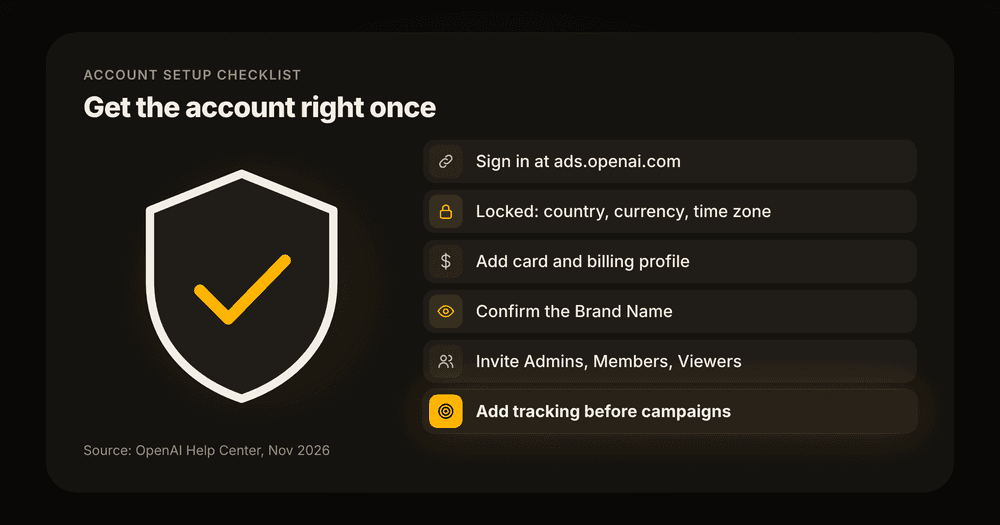
OpenAI's own guidance points the same way. Search Engine Land reported that OpenAI advises agencies and freelancers not to create accounts for clients. The client signs up, then invites the agency from Settings, Users. Ownership matters more here than on Google Ads, because the Legal Name drives billing and business verification. Change it later and business review starts over.
Watch out: Country, currency and time zone can't be changed after account creation. Get them right with the client on the first call. A wrong currency means a new account.
Agency roles
The agency should get the Member role for campaign work, and the client keeps at least one Admin. Ads Manager has three roles:
| Role | What it can do | Who gets it |
|---|---|---|
| Admin | Full access, including users and billing | The client's owner, plus the agency lead if the client agrees |
| Member | Create and manage campaigns | Agency account managers |
| Viewer | View only | Client stakeholders, finance |
One OpenAI login can belong to many advertiser accounts and switch between them. That gives you a multi-client view of sorts, one account at a time. API keys are a separate matter: Supermetrics' docs note that generating an Ads API key needs Admin permission. If you plan to pull data into reporting tools, ask for that key at onboarding.
Where ChatGPT ads fit
ChatGPT ads fit between search and social: they catch people while they research, before they type a product name into Google. Ads appear below ChatGPT's answers for logged-in adults on the Free and Go tiers. OpenAI says it doesn't show ads on Plus, Pro or any Business plan, or to users it believes are under 18.
OpenAI puts ChatGPT at more than 1 billion weekly active users (August 2026), so reach isn't the problem. Intent is what you plan around. A lot of ChatGPT users are still asking "which one should I get?" when the ad shows up, a step before "buy X now". That puts the channel closer to upper-funnel search than to Performance Max. Our ChatGPT Ads guide covers the ad format itself.
Verdict: Give ChatGPT Ads its own test line in the media plan, separate from the search budget, so the two never compete for the same money in month one.
Which clients go first
Clients whose buyers research before they buy should test first. Good fits share a few traits:
- A considered purchase where buyers compare options (software, travel, education, financial products, home services).
- A clear answer to "which one is right for me", so the ad can help the conversation.
- Conversion tracking that already works in GA4 or a CRM.
- Enough monthly budget that $750 to $1,500 of testing won't distort the rest of the plan.
- For e-commerce, a clean product feed, since OpenAI added product feeds and custom audiences in 2026.
Poor fits are impulse buys, local emergency services and anything in a restricted category. OpenAI's ad policies allow only a narrow range of health ads from selectively approved advertisers.
How much to budget
A ChatGPT Ads test needs at least the platform minimum: 25 a day in USD, CAD or AUD accounts, or 15 in GBP and EUR accounts. That figure works as a weekly average, so one day can spend up to double it while a Sunday-to-Saturday week caps at seven times. Our OpenAI Ads Manager walkthrough covers the pacing in detail.
For click campaigns, OpenAI recommends a starting maximum bid of $3 to $5 per click. Here is what those bids buy, as plain arithmetic:
| Daily budget | Assumed CPC | Clicks per day | Clicks in 30 days |
|---|---|---|---|
| $25 | $5 | 5 | about 150 |
| $25 | $3 | about 8 | about 250 |
| $50 | $4 | about 12 | about 375 |
A few hundred clicks will tell you whether the traffic converts, though it's too few to optimize hard. Our starting rule, and this is opinion: run 30 days at $25 to $50 a day out of the experiments budget, and leave search and social alone.
Bidding also changed this month. OpenAI's help center says Target CPA replaces Max Bid for conversion campaigns, and Target CPC replaces Max CPC for click campaigns, with migration from November 9, 2026. Check which option a client's existing campaigns use before you report on them.
Worked example: context hints
ChatGPT Ads targets with context hints, not keywords. OpenAI says hints guide matching but aren't exact-match keywords. So we tested where those hints should come from.
The data comes from a Canadian exam-prep business one of our team runs on the side (Google Ads, GBP, last 30 days to November 25, 2026). We asked Claude, connected to the account through HYPD:
Pull the last 30 days of search terms for this account. Split them into question-style queries (how, what, should, which, vs) and short product queries. Show spend and conversions for each group. Then draft five ChatGPT Ads context hints from the research questions buyers ask before they search for an exam name.
What the data showed
The search term report was almost all exam names. Here is what came back for the top 300 search terms by spend:
| Query type | Example | Terms | Spend | Conversions |
|---|---|---|---|---|
| Exam-name, product and brand queries | "309a practice exam" | 297 | about £235 | about 12 |
| Question-style queries | "what is red seal electrician" | 3 | £0 (7 impressions, 0 clicks) | 0 |
Every paid click came from exam-name, product or brand queries. The research questions barely show up in Google Ads at all. Our guess is that people ask those questions in a chat window now, and only reach Google once they know which exam they need.
The hints Claude drafted
Claude drafted five context hints from the question-style terms and the exam names:
1. An electrical apprentice asking how many hours they need before they can challenge the Red Seal exam. 2. Someone comparing the 309A and 442A licences in Ontario. 3. An apprentice asking how hard the Red Seal electrician exam is and how to study for it. 4. An electrician asking what the Canadian Electrical Code section of the exam covers. 5. Someone who failed the 309A and wants a study plan for the retake.
Verdict: Write context hints from the questions your client's buyers ask before they decide. The search term report only shows what they type once they have, and ChatGPT is where the deciding happens.
From our tests: The search data was just as useful for showing what to leave out. Hints built on short exam names would mostly rebuy people Google Ads already reaches.
How to measure results
Measure ChatGPT Ads in the same place you judge every other channel: GA4, the CRM or the client's order data. Ads Manager reporting is useful for delivery, but it can't settle a budget argument on its own.
Set up three things before launch:
1. The OpenAI Pixel or the Conversions API, so conversion campaigns have a signal. Existing CPM or CPC campaigns can't be converted to oCPC, so decide the objective first. 2. UTM parameters on every ad. OpenAI says its tracking parameters persist on ad clicks for use in existing analytics tools. 3. A landing page that OpenAI's crawler can reach, with no login wall.
Attribution in Ads Manager is last-touch, with click windows of 7, 14 or 30 days and view windows of 0 or 1 day. Expect attributed conversions to take 24 to 48 hours to settle. Spend takes about 7 to 8 hours.
The bigger gap is visibility. Adweek reported on November 23, 2026 that OpenAI's ad system writes its own search queries from the conversation, and advertisers only see aggregate results. There is no search term report to mine.
Verdict: Don't compare ChatGPT's platform-reported ROAS with Google's or Meta's. Each platform grades its own homework differently. Compare GA4 sessions, conversions and cost per acquisition from one source, in the same monthly client report you already send.
Tools across clients
Agencies manage ChatGPT Ads across clients with four kinds of tools. There's an MCP server that connects the account to Claude or ChatGPT, OpenAI's web app and its ChatGPT Ads Manager plugin, or a reporting platform such as Supermetrics. We build one of those MCP servers, so we have a stake, and at least one of the verdicts below goes against us.
HYPD
HYPD is the AI co-pilot for performance marketers: it connects Google Ads, Meta Ads, GA4, Merchant Center, Search Console, Microsoft Ads and LinkedIn Ads to Claude and ChatGPT through MCP, read-only by default, EU-hosted and GDPR-compliant. ChatGPT Ads isn't part of the hosted HYPD connector yet.
For ChatGPT Ads, HYPD publishes a separate OpenAI Ads MCP server. It is free, open source (MIT) and read-only, with 11 tools covering accounts, campaigns, ad groups, ads and reporting. It runs locally through npx with one API key per ad account. The source is on GitHub. Because the tools are read-only, the server can't spend budget or change a campaign.
Verdict: Best fit if you already run Google and Meta through HYPD and want ChatGPT Ads in the same Claude conversation. Two servers, one chat. Per-client permissions and the audit log don't cover the OpenAI Ads MCP yet.
OpenAI Ads Manager (web app)
Ads Manager at ads.openai.com is the only place for billing, business verification and bulk upload. It can create and edit everything, but there's no cross-client view beyond switching accounts.
Verdict: Required. Every client account lives here, whatever else you use.
ChatGPT Ads Manager plugin
OpenAI's plugin runs inside ChatGPT and Codex and can create and edit campaigns. It shows a preview and waits for approval before creating anything. Identity verification, billing and tax still happen in the web app.
Verdict: Good for quick builds and edits inside ChatGPT. It only covers ChatGPT Ads, so it won't help with the Google and Meta side of a client report.
| Tool | Writes to ChatGPT Ads | Cross-channel in one place | Per-client access control | Cost |
|---|---|---|---|---|
| HYPD OpenAI Ads MCP + HYPD connector | No, read-only | Yes, two servers in one chat | Yes for HYPD platforms, not yet for OpenAI Ads | MCP server free; HYPD from $0 |
| OpenAI Ads Manager | Yes | No | Yes (Admin, Member, Viewer) | Free (you pay for media) |
| ChatGPT Ads Manager plugin | Yes, with preview and approval | No | Uses Ads Manager roles | Free |
| Supermetrics | Yes, through its MCP | Yes, 100+ sources | Through Supermetrics sharing | Supermetrics subscription |
Where it falls short
ChatGPT Ads still asks agencies to accept less control than search. You can't see the queries the system writes or force a match with a hint, and a campaign's objective is fixed once it launches. Clients used to search term reports will ask what triggered their ads. The honest answer is that nobody outside OpenAI knows.
AI tools don't fix that gap. Claude can summarize a ChatGPT Ads account and draft hints from search data, as in the example above. It can't tell you whether those ChatGPT clicks were incremental, or whether the same buyers would have found the client on Google a day later. That needs a holdout test or a geo split, and a human to design it.
Our own setup has limits too. The OpenAI Ads MCP needs one key per ad account, so thirty clients means thirty keys to collect and store safely. Ask each client's Admin for a key at onboarding and store it in a password manager. A read-only key still exposes spend and performance data.
The decision
Add ChatGPT Ads to the client media mix as a funded experiment and leave the existing budgets where they are. Have the client own the account, take the Member role, track conversions in GA4, and give it 30 days at the platform minimum or a little above. Write context hints from research questions and report the channel next to Google and Meta from one data source. And tell the client up front that there's no query-level data. If the traffic converts at a cost per acquisition the client can live with, scale it from the search budget in month two. If it doesn't, the client has paid $750 to $1,500 for a clear answer.
If you want ChatGPT Ads in the same conversation as Google and Meta, connect the OpenAI Ads MCP next to HYPD's free plan and run the worked example prompt on your own account.
FAQ
An agency shouldn't create a ChatGPT Ads account for a client. OpenAI advises agencies and freelancers against it. The client creates the account in Ads Manager and invites the agency from Settings, Users, usually with the Member role.
ChatGPT ads cost what the auction sets, billed by CPM, CPC or conversion-optimized bidding. OpenAI recommends starting CPC bids of $3 to $5. The minimum daily budget is 25 in USD, CAD and AUD accounts, and 15 in GBP and EUR accounts.
Yes, one OpenAI login can belong to several advertiser accounts and switch between them in Ads Manager. There is no combined cross-client dashboard in Ads Manager itself, so agencies use reporting tools or MCP servers for that view.
OpenAI hasn't published an official MCP server for ChatGPT Ads as of November 2026. OpenAI offers the ChatGPT Ads Manager plugin inside ChatGPT. HYPD's OpenAI Ads MCP is a free, read-only community project, not affiliated with OpenAI.
ChatGPT ads run in more than 40 countries. Self-serve Ads Manager opened in the US in May 2026 and later in the UK, Europe, India, the Middle East and North Africa. Aleph resells ChatGPT Ads in 44 markets across Latin America, Europe and Central Asia, the Middle East and Africa, and Asia-Pacific.